

Key takeaways
- Work from the claim to the product, and write down the reason: that, not the label, is what a reviewer checks.
- A product record that doesn't mention a feature has not shown that the feature is absent. "Uncertain, ask engineering this question" is a better row than a guess.
- Rows do not add up to a conclusion. Every limitation of a claim matters, and each independent claim stands on its own.
A relevance score can't tell you which part overlaps or what to change. A claim chart can, if every row says why. Whoever drafts the chart, the same three mistakes come up: marking a limitation as met because the names look alike, marking a feature as absent because nobody described it, and counting matching rows as if they added up to a risk score.
Each of the five steps covers the work by hand, what the FTO Search workflow in Patsnap Eureka IP Search does, an example, and what you still decide. The team situations are anonymized from real conversations; they describe working problems, not measured product results.
1. Pin down what you are comparing
By hand. Record the product side: version, configuration, operating mode, and which statements engineering has confirmed. Record the patent side: the family member covering your market, its status (pending, granted, or no longer in force), and the claim text and date you used.
What Patsnap Eureka does. It refines your input into a technical description, then extracts product features: components, relationships, operating steps, and functional details. That description is the comparison's only product record, and rules require rows to quote continuous text from it, so a quote is only as accurate as the description behind it. Inferred details, such as a groove shape, can appear in the product column, labeled as inferences.
What it looks like. A hardware team selling into North America and Europe splits FTO work between in-house staff and outside firms; without a shared record, each new reviewer rebuilds the product mapping.
What you still decide. Turn what drawings show into confirmed text before you submit. Rows built on inferred details stay provisional until engineering confirms those details. This method applies to utility patent and utility model claims; design patents are analyzed differently.
2. Read the claim structure, then split it
Each limitation is one requirement of the claim.
By hand. Copy out each claim, find which are independent and what each dependent claim refers back to, then split the text into limitations. A dependent claim carries every limitation of its parent; where it refers back to several claims in the alternative, follow each path separately. Splitting is where meaning gets lost:
A controller stops the motor drive once the detected clamping force meets a preset condition.
Split into "controller," "clamping force," and "motor," the limitation loses what is detected, what condition must be met, and what the controller then does. A product can contain all three elements and still run a different control sequence.
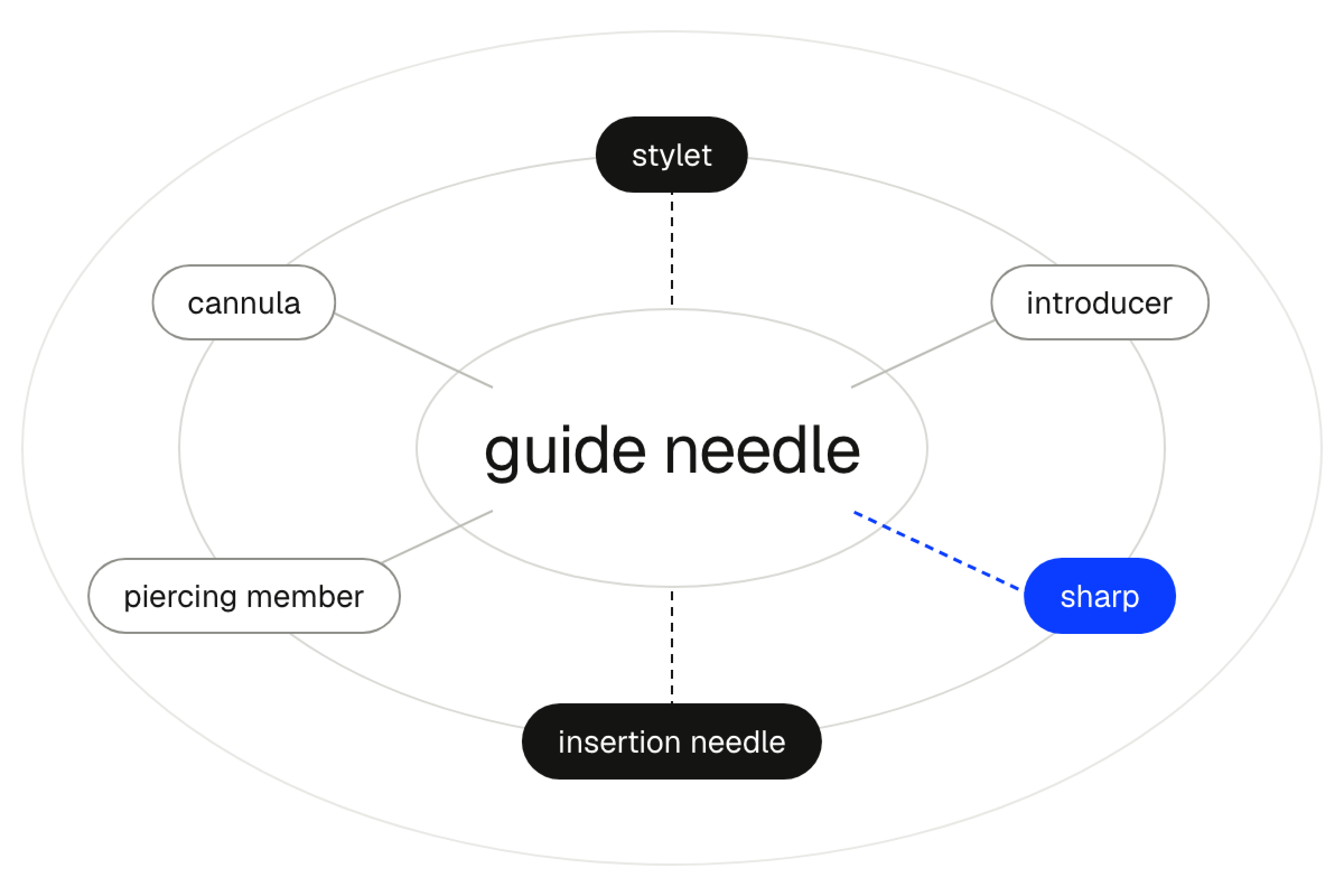
What Patsnap Eureka does. It works in two passes. First it records each claim's number, whether it is independent or dependent, and what it refers back to. Then it splits the claim into numbered technical features (its term for limitations), under rules that require each feature to keep its components, connections, positions, steps and conditions, materials, and values, rather than cutting at punctuation.
What it looks like. At one materials company, a general-purpose chatbot produced a differently structured claim table from the same prompt the next day, and the claims still needed manual review. Organizing output around claim, feature, correspondence, and reasoning gives review a more consistent structure, though regenerated output can still change.
What you still decide. The current workflow focuses on independent claims. A recognized dependency is not an analyzed dependent claim; to assess one, check its full chain of limitations and the dependency itself. Claims that were not analyzed, failed to process, or returned too little material have not been ruled out. One part can carry several limitations.
3. Map each limitation to the product
By hand. Each row asks one question, in one direction: the claim requires this, so what product fact supports it? If the claim requires a lever rotatably connected to a support by a pivot pin, a record listing "lever, pin, support" is not yet a match. You still need to know what the pin connects, whether the lever rotates, and whether all three belong to this configuration. Across every claim of every candidate, this is where the hours go.
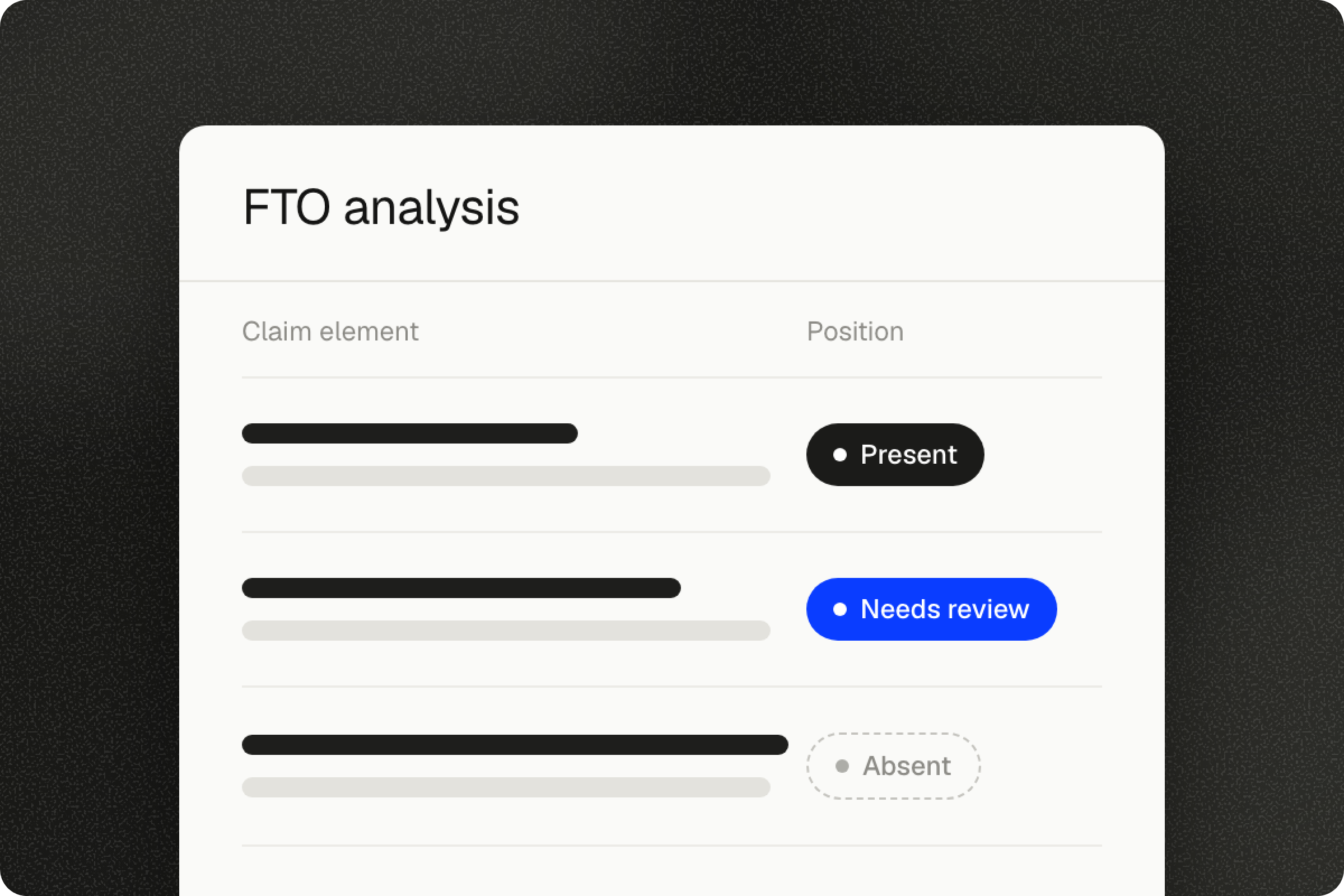
What Patsnap Eureka does. For each claim feature, it returns the related product feature, a correspondence type, and a reason. Rules require quoting continuous text from the technical description so the basis can be checked, and mapping feature by feature turns "relevant" into specific structures, connections, and steps that engineering can confirm. Where related specification information is available, it helps read claim terms that differ from engineering language.
What it looks like. Each row pairs one numbered feature with the product passage, the correspondence type, and the reason.
What you still decide. Check each quote against the text you confirmed, and each split and specification link against the patent: any of them can be wrong or incomplete. The specification helps you read the claim but cannot fill gaps in the product record, and an embodiment's preferred material shouldn't be read into the claim without a reason. Don't mix parts or operating modes in one row, and in method claims, don't treat what a product can do as what it does; check who performs each step.
4. Judge and check each row
Most rows end in one of four results, which we call the row's correspondence type. These are analysis terms; the interface may label them differently.
| Result | What to write in the row |
|---|---|
| Met directly | The product fact and why it falls within the claim's wording; if inferred, each step of the inference |
| Possibly met by an equivalent | The difference, broken into function, way, and result |
| Uncertain | The specific question that would settle the row |
| Not met, literally or by an equivalent | The stated difference, and why no reasonable equivalent applies |
By hand. Row by row, a silent record tempts a guess. Write it as met and the chart claims overlap the record can't show; write it as absent and one guessed row can take a whole claim out of review.
What Patsnap Eureka does. It checks in the order of the table: first for a direct match, then whether a difference may be equivalent. When the row can be neither confirmed nor ruled out, including where the record is thin, it returns an uncertain result with its reason, which the team can turn into follow-up questions. Its rules allow a not-met result only when the basis for the difference is sufficient. Each feature is read alongside related features in the same claim.
What it looks like. Illustrative only: part of one claim for a fictional door lock, not Patsnap Eureka output. Assume engineering has confirmed the product statements.
| Claim limitation (excerpt) | Product evidence | Correspondence type | What to check next |
|---|---|---|---|
| The battery is located inside the housing | The battery sits in a compartment entirely inside the housing | Met directly, by inference (the compartment is inside the housing) | That both statements describe the same configuration |
| A coil spring provides return force by compression | A compressed rubber block recovers its shape and returns the bolt | Possibly met by an equivalent | Function, way, and result, and the basis for the substitution; whether prosecution history limits equivalents |
| An alert is triggered within a set time after a state change | An alert is triggered after a state change | Uncertain: no timing information | Control parameters or test records |
| Distance is measured by ultrasonic transmission and echo reception | No ultrasonic transmitter or receiver is present; other distance-measuring mechanisms have not been checked. | Uncertain: literal absence recorded | Whether an equivalent implementation exists: does any other feature perform the distance-measuring role? |
Harder cases for each result:
- Met directly. "Hinged" and "rotatably connected by a pivot pin" can describe the same connection once a drawing confirms it. A claim to "metal" generally covers an aluminum alloy; a record saying only "metal" does not establish an alloy the claim requires. An inferred match fails if another reasonable design fits the record but lacks the feature.
- Possibly met by an equivalent. "Both return the bolt" shows only a similar function. How the rubber block takes load, deforms, and recovers, and whether operating conditions change, still need analysis. A material change alone doesn't settle it.
- Uncertain. A patent services firm working from short client summaries knows the claims but not always the engineering. When a summary names a "damping assembly" without describing its structure, that row stays open until someone asks. Uncertain is a result, not a failure to finish.
- Not met. This needs positive support. "Not found in the current text" doesn't usually carry that weight. The ultrasonic row has that support for literal absence; it becomes Not met only once the equivalents question is answered.
What you still decide. Put three questions to every row:
- Does the limitation drop a condition from the claim?
- Does the evidence state an actual product fact?
- Does the correspondence type claim more than the evidence supports?
Put the same three questions to each row Patsnap Eureka returns: the feature split, the quoted passage, and the type against its reason. Interface labels organize the analysis; they are not legal conclusions or a finding under any jurisdiction's doctrine of equivalents. Whether a substitute counts as an equivalent depends on the jurisdiction; see the Jurisdiction note below. Functional wording, such as "a unit for detecting X," needs its scope settled under local law before you map the product.
5. Put each claim back together and hand it off
By hand. It is tempting to count rows. In general, every limitation must be met, literally or, where the jurisdiction allows, by an equivalent, so one limitation reliably shown to be neither affects whether the whole claim is met. Matching rows are not a probability of infringement. Nor can independent claims be averaged: one claim that deserves attention is not offset by the others, and setting one aside does not rule out the whole patent.
What Patsnap Eureka does. It rolls feature results up to the claim and patent level under rules that lean toward caution: a claim can stay in review when one feature differs, so someone checks the difference. That does not mean every limitation is met. Feature rows stay attached, so each independent claim opens on its own, and you can change a correspondence type or claim-level judgment, save it, and compile the analysis into a report.
What it looks like.
What you still decide. If every limitation has a direct or possible equivalent correspondence, review the full claim, especially the equivalents reasoning. If a limitation is unclear, gather evidence for that gap. If one clear difference appears, check its basis, then the patent's other claims. Relevance in the results list can reflect an overall assessment, so use it to choose what to read first: high relevance is not infringement, and low relevance is not safety.
Before the chart goes out, check it top-down:
- Patent: publication number, family member and legal status in the target market, claim text version, the scope of this analysis, and which claim triggered attention.
- Claim: wording, dependencies, and whether every limitation appears in the chart.
- Limitation: evidence and reasoning; compare reworded or translated limitations with the original, especially negatives, numbers, and units.
Engineering confirms the facts, the IP team checks scope and reasoning, and outside counsel applies the law of each market. Saving one row's change may not update related results: recheck before the report, and compare any regenerated chart with the signed-off version. The chart covers only the candidates and claims that reached it; it does not show that nothing else applies.
Five questions to send engineering before the next round
- Which product version and operating modes are in scope?
- Which components are involved, and how do they connect?
- What is the control logic or process sequence?
- What are the key parameters, and under what conditions were they measured?
- What hasn't been decided yet?
Jurisdiction note
This note covers the US, the EPC, and China; check each target market with counsel.
- US. Equivalents are assessed element by element, for example by asking whether the substitute matches the function, way, and result of the claimed element [2]. Narrowing amendments made during prosecution can limit the equivalents available [4]. Functional wording may be construed under 35 U.S.C. 112(f) [5].
- EPC. The claims determine the extent of protection, interpreted with the description and drawings [1]. Due account is taken of elements equivalent to those in the claims [3]; national courts and the Unified Patent Court apply their own tests.
- China. Every technical feature of the claim must be present, identically or equivalently [7, Art. 7]. An equivalent uses basically the same means to perform basically the same function and achieve basically the same effect, and could have been thought of by a person skilled in the art without creative effort at the time of the alleged infringement [6]. A technical solution given up by amendment or statement during grant or invalidation proceedings cannot be brought back into scope [7, Art. 6], unless that narrowing was expressly rejected [8, Art. 13]. A functional feature is compared with the features in the description and drawings that are indispensable to its function or effect [8, Art. 8].
Disclaimer: This article is general information, not legal advice or an FTO opinion. Claim interpretation, equivalents, and infringement depend on the jurisdiction and the facts. Consult qualified counsel before making a legal or commercial decision about a specific product.
Sources
- European Patent Convention, Article 69: extent of protection
- USPTO MPEP 2186: relationship to the doctrine of equivalents
- Protocol on the Interpretation of Article 69 EPC
- Festo Corp. v. Shoketsu Kinzoku Kogyo Kabushiki Co., 535 U.S. 722 (2002)
- USPTO MPEP 2181: identifying and interpreting 35 U.S.C. 112(f) limitations
- Several Provisions of the Supreme People's Court on Issues Concerning the Application of Law in the Trial of Patent Dispute Cases (2020 revision), Article 13 (Chinese)
- Supreme People's Court: Interpretation on patent infringement disputes, Fa Shi (2009) No. 21, Articles 6 and 7 (Chinese, WIPO Lex)
- Supreme People's Court: Interpretation II on patent infringement disputes, 2020 revision, Articles 8 and 13 (Chinese)