

Event recap


A clasp-free bracelet has to stretch over a hand, then spring back and stay in place. That simple trade-off anchored the design exercise we prepared for "Hands-on AI for R&D: From Research to Innovation," Patsnap's SWITCH Beyond workshop at the Singapore Week of Innovation and Technology (SWITCH) 2026 on October 28. The session was for R&D professionals, engineers, scientists, innovation leaders, deep-tech founders, and investors, and it asked everyone to bring a laptop and one real question. This recap shares the questions and the prompts from the workshop materials, so you can run the same exercise on your own problem.
The question we opened with
SJ opened with a hypothetical we would put to any R&D team: "You have $1 million to back an innovation. What would you need to know before saying yes?"
There is no single right answer, because the first question depends on who is asking:
- Engineers and scientists ask: Will it work?
- IP and research teams ask: Has it been done?
- Founders and strategy teams ask: Who else is doing it?
- Investors and commercial teams ask: Who needs it?
These questions follow an innovation through its whole life, which we framed as five stages, each with one question:
- Discover: Where is the opportunity?
- Design: Which route should we try?
- Test: What could fail?
- Protect: What is already known?
- Scale: Will it create value?
A research question today becomes a design, IP, or market decision tomorrow. Evidence gathered at one stage should carry into the next.
Why the evidence layer matters
SJ's central point: a fluent AI answer is not necessarily an evidence-backed R&D answer. A general model can answer broad questions well. A decision about whether to fund, design, protect, or launch something also needs evidence an expert can check: the patents, papers, and market data behind the answer.
We described that evidence layer in three parts:
- Breadth: patents, scientific publications, companies, legal records, funding, and market signals.
- Depth: technical disclosures, patent families and claims, legal context, and domain-specific attributes.
- Connectivity: relationships among inventions, organizations, technologies, and commercial activity.
Before AI can work with these sources reliably, the data has to be cleaned and standardized, enriched with technical attributes, and connected through entity relationships and data governance. Patsnap, headquartered in Singapore, has nearly two decades of structured patent and paper data. Better data supports better AI-assisted decisions, and human validation still matters.
One bracelet, five stages
Ken Kong's part of the session covered what is working with AI in R&D. For the workshop, we prepared a clasp-free bracelet design exercise.
The brief: you are a product development engineer designing a clasp-free, non-electronic bracelet for daily wear. It has to stretch over a range of adult wrist sizes, recover its shape, stay comfortable against skin, and withstand sweat, water, and repeated use. Your scope runs from problem definition through design routes, material screening, screening for potential freedom-to-operate risks, and commercial opportunity in the U.S. and Europe.
The product is simple on purpose, so the trade-off is easy to grasp.
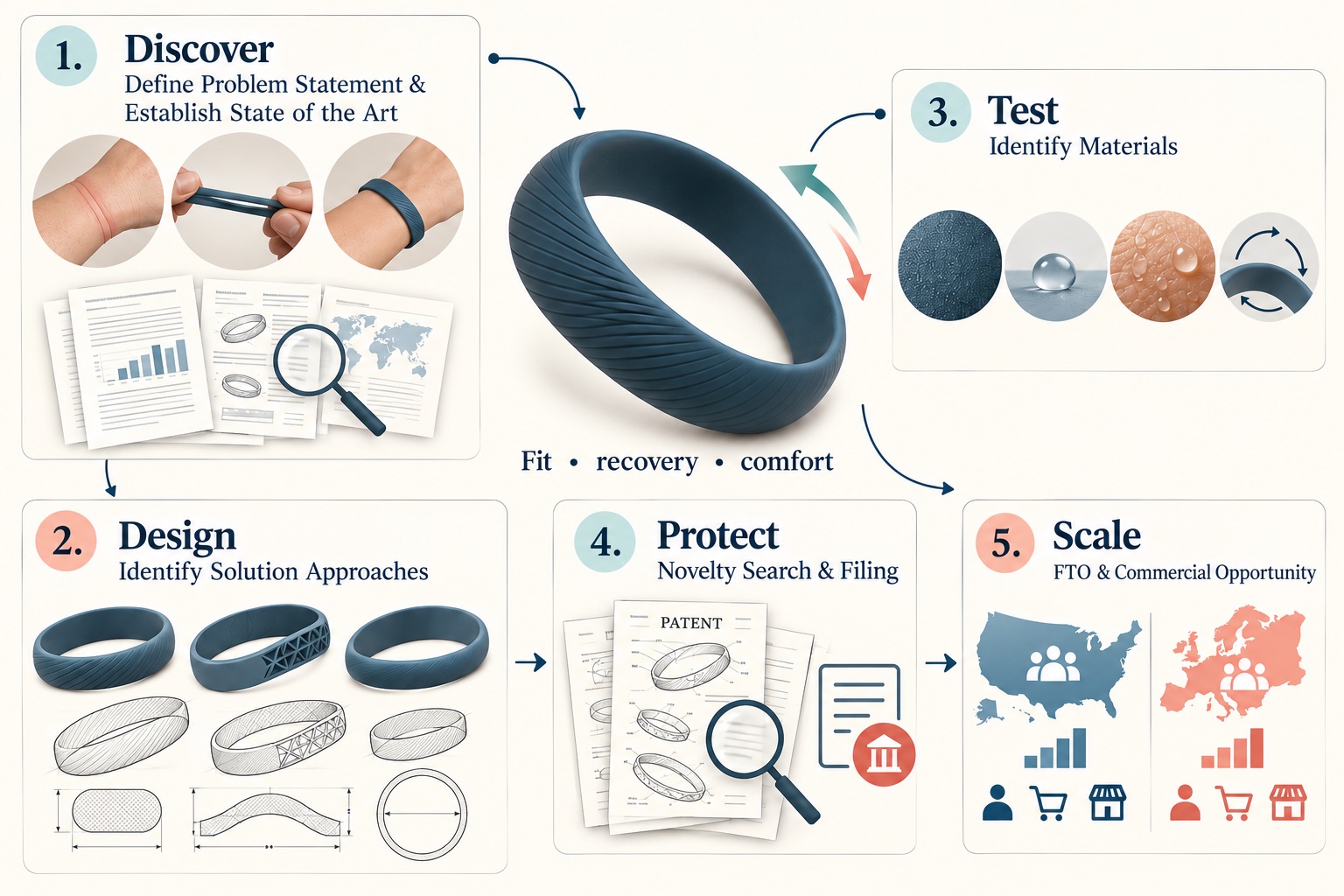
The workshop materials provide prompts in Patsnap Eureka for each stage:
- Discover. Define the engineering problem, separate essential requirements from preferences, and name the contradiction. An excerpt from the workshop prompt: "Analyze the contradiction between making a clasp-free bracelet stretch easily over different adult wrists and maintaining a secure fit and shape recovery during daily wear."
- Design. Review existing approaches, including elastic-cord bracelets, expandable metal-link bracelets, spring-loaded mechanisms, articulated structures, and compliant mechanisms, then generate new mechanisms, including concealed expansion designs that keep a smooth exterior.
- Test. Screen candidate materials such as stainless-steel spring alloys, titanium alloys, nitinol, thermoplastic polyurethane, and silicone elastomers, comparing elastic strain, fatigue resistance, creep, stress relaxation, corrosion resistance, skin-contact suitability, and manufacturing compatibility.
- Protect. Run a novelty search on the new ideas to see what prior art already exists and flag issues early in the project.
- Scale. Screen for potential freedom-to-operate risks in the target markets, and search for a commercial partner or licensee.
Each stage feeds the next. The contradiction defined in Discover shapes the mechanisms in Design, and the mechanisms decide which materials are worth screening. None of the routes is a finished answer. Each still needs testing and expert judgment.
Bring your own question
The agenda reserved time for a hands-on exercise with the Patsnap team. The workshop materials framed it with one question: "If AI could help investigate one challenge today, what would you ask?"
You don't need to be an AI expert or write a perfect prompt. Start with a decision you care about, from one of four places:
- Explore a technology
- Solve a bottleneck
- Understand competitors
- Test an idea
A principle from the workshop materials applies to all four: AI speeds up the investigation, but it does not replace experimentation or expert judgment. If you have an R&D question of your own, the five stages above are a practical way to work through it.