
Perovskite tandems: record efficiency, little production data
Record efficiencies are in. Production-scale reliability data is still missing.
Record efficiencies are in. Production-scale reliability data is still missing.
LONGi, Trinasolar, and Oxford PV have each posted a perovskite-silicon tandem milestone between September 2024 and July 2026: a cell efficiency record, an industrial-size module, and an initial commercial shipment and later licensing agreements. This analysis compares the public evidence as of July 2026. It is for R&D, product, and technology strategy teams who need to read those announcements side by side, and it sets out what each milestone can answer, which patent routes sit behind it, and what evidence is still missing before tandem modules become a repeatable, bankable product.
On July 14, 2026, LONGi announced a new world record: 35.5% efficiency for a crystalline silicon-perovskite tandem cell, which it says was certified by the European Solar Test Installation (ESTI).
The number matters. It is also easy to overread.
In June 2026, Trinasolar announced a 907W tandem module with 29.2% full-area efficiency, built on a standard industrial area, with output and efficiency it says TÜV SÜD verified. Oxford PV, meanwhile, had already shipped what it describes as the first commercial perovskite-silicon tandem modules, and later licensed part of its patent portfolio.
These announcements belong to the same race, but they sit at different points between laboratory performance and a repeatable, financeable product. The useful comparison asks what each milestone can answer.
The analysis compares three visible milestones and the engineering questions underneath them. It is not a complete market ranking.
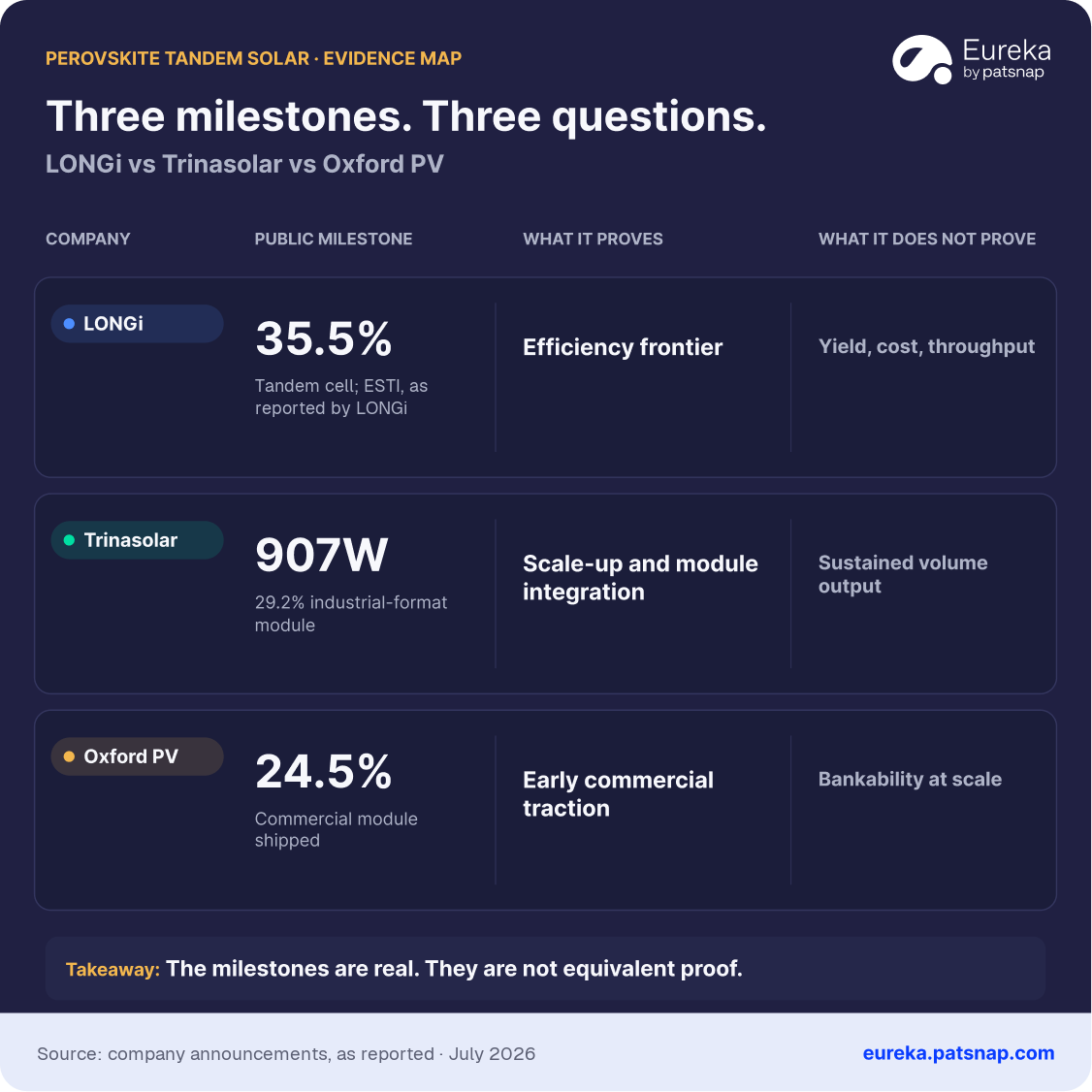
LONGi answers the cell-performance question. The 35.5% result shows how far the tandem architecture can push certified efficiency. LONGi also reported 34.3% on a 261 cm² device and 32.2% on a 274 cm² device, as well as tandem module efficiencies of 31.4% and 29.4%. The company says the module results were independently certified, without naming the institutions in its announcement.
Those larger-area results matter because area, texture, interconnection, and process variability become harder to control as devices scale. They move the evidence beyond a single small champion cell.
They do not disclose production yield, sustained throughput, manufacturing cost, or shipment volume. The defensible conclusion is narrow: of the three companies reviewed, LONGi reports the highest certified cell efficiency, and its public announcements as of July 2026 do not establish repeatable high-volume output.
Trinasolar answers the industrial-module question. The company says its 907W module is based on a standard industrial area, complies with mainstream industry specifications, and uses a 210mm tandem cell system. It says TÜV SÜD verified the reported 907W output and 29.2% full-area efficiency.
That is a different scale-up signal from a champion cell. Film uniformity, passivation, spectral matching, interconnection, and module architecture all feed into the result.
A record module is still a selected result rather than a production distribution. It does not reveal median efficiency, line yield, cycle time, or cost across sustained manufacturing.
Oxford PV answers the early-commercialization question. In September 2024, Oxford PV shipped its first commercial perovskite-silicon tandem modules to a US customer for a utility-scale installation. The delivered 72-cell modules had 24.5% efficiency. Its 26.9% figure, which it says Fraunhofer CalLab certified in June 2024, came from a separate 60-cell record module, not the shipped product.
Oxford PV later signed an exclusive license for the Chinese market with Trinasolar, including a right to sublicense (April 2025), and a non-exclusive US license with First Solar (February 2026). According to Oxford PV's announcement, the US agreement excludes crystalline silicon semiconductors.
These transactions show that Oxford PV's portfolio has become a commercial asset. They do not establish that every tandem route requires an Oxford PV license, or that the company has already proven manufacturing scale and bankability.
Each milestone answers a different question, and none of them settles the other two.
Here, patent data is most useful for showing technical direction. Counting documents and ranking the totals would tell you little.
LONGi's representative filings point toward interface and deposition control.
Trinasolar's representative filing points toward silicon-platform integration. CN113013277A (Trina Solar) describes a tandem cell that uses an inverted TOPCon cell as the bottom cell, with the perovskite cell built on it.
The 907W announcement is separate evidence. It describes an industrial-size module and a 210mm tandem cell system, but it does not say which bottom-cell structure the module uses. Read the patent and the module result as two signals, not as a description of one product.
The TOPCon bottom-cell route is not unique to Trinasolar. Other filings include CN113206123A, originally filed by Nanjing University (a perovskite/TOPCon tandem in which the n-type doped polysilicon layer of the TOPCon cell and the hole transport layer of the perovskite cell together form the tunnel junction), and CN117337065A from Xuancheng Advanced Photovoltaic Technology (a TOPCon/perovskite structure with a double-passivation design).
Oxford PV's visible strategy combines portfolio protection and commercialization. Its granted patent portfolio, the 2024 shipment, and the licenses that followed show a strategy that connects device and manufacturing IP with market access.
The evidence types must stay separate. Patent families indicate technical and strategic direction. Shipments and licenses indicate commercial action. Neither category on its own proves yield, freedom to operate, essentiality, or market leadership.
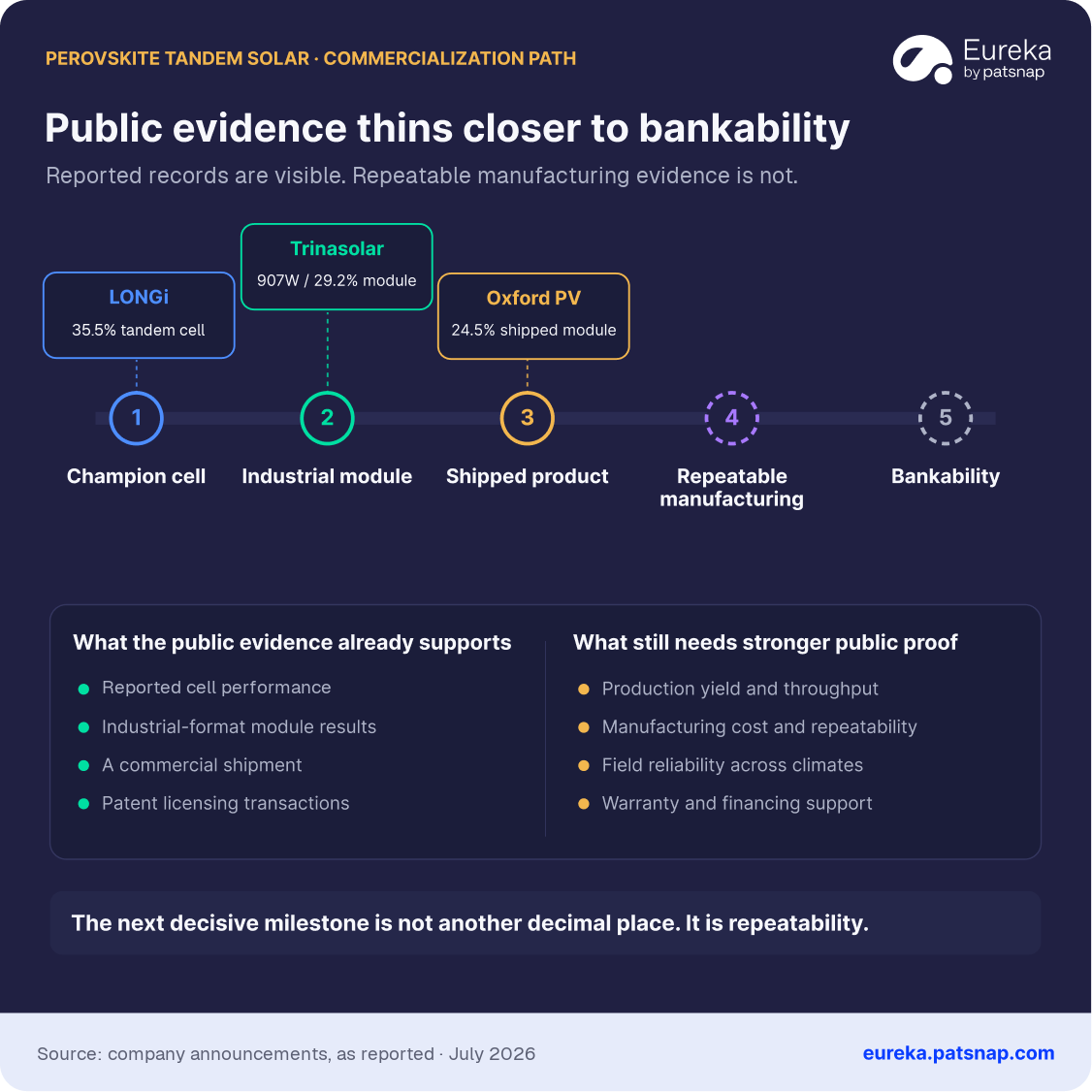
The US Department of Energy groups the commercialization problem into four connected challenges: stability and durability, efficiency at scale, manufacturability, and technology validation and bankability.
1. Repeatability, not another decimal place. Champion results prove that an architecture can work. Manufacturing requires a stable distribution of results across runs, tools, and material lots. Public announcements rarely include median efficiency, yield, downtime, or process capability.
2. Module integration at industrial area. Larger devices add inactive area, interconnection loss, encapsulation effects, and uniformity challenges. Trinasolar's module is therefore meaningful, but the missing evidence is sustained production rather than a higher selected output.
3. Reliability must connect accelerated testing to field life. Accelerated laboratory tests run for weeks or months, while module warranties run for decades. Accelerated tests alone cannot establish field life or support a long-term warranty. Heat, humidity, UV exposure, electrical bias, and thermal cycling require validated degradation models across climates and module designs.
4. Bankability is a system property. A shipped product is not automatically financeable at scale. Warranty backing, supplier strength, field history, production statistics, and replacement risk all affect whether capital providers can underwrite deployment.
A 2024 reliability review in Energy & Environmental Science, with authors from NREL, industry, and several research institutions, concluded that perovskite-silicon tandem devices were not yet reliable enough to establish confident commercial viability.
Cell efficiency has moved since then. In the three cases reviewed here, public evidence on repeatable manufacturing and field reliability had not moved at the same speed as of July 2026.
The comparison below covers only the three companies reviewed, as of July 2026. It is not a recommendation. It keeps one metric from being asked to answer a question it was never designed to answer.
Match the evidence to the constraint, then validate the route in your own scope, keeping patent evidence separate from performance and commercial disclosures.
Signal 1: LONGi manufacturing commitment (monitoring, watch: H2 2026). The next stronger signal would be a named pilot or production line with capacity, process configuration, and start date. A capacity announcement without yield or throughput evidence would still leave the repeatability question open.
Signal 2: Trinasolar production evidence (monitoring, watch: 2026 to 2027). The next signal is sustained production evidence, including capacity allocation, median output, yield, and cost relative to conventional silicon modules.
Signal 3: Oxford PV scale and license boundaries (monitoring, watch: 2026 to 2027). The next questions are manufacturing expansion, license implementation, and the boundary between crystalline silicon tandem routes and other perovskite applications.
Signal 4: Independent reliability evidence (open, watch: 2026 to 2028). The reliability announcement that matters most will connect accelerated testing, outdoor exposure, and a credible lifetime model to a commercially meaningful warranty.
Signal 5: Repeatable full-size output (open, watch: 2027). A disclosed distribution of production results would change the evidence hierarchy more than another selected record. Watch for median module efficiency, yield, throughput, and failure-mode data from a named line.
The tandem race does not lack breakthroughs. It lacks equivalent evidence.
LONGi's cell record, Trinasolar's industrial module, and Oxford PV's shipment and licenses all matter, for different reasons. Before you act on any of them, ask what the milestone shows, which engineering decision it supports, and what is still missing: production output, yield, and outdoor field data.
About the author
Zoe Zhao publishes Evidence & Engineering, a field journal on evidence-driven engineering decisions from the team behind Patsnap Eureka. Her other analyses for the journal cover sodium-ion batteries and the 2nm foundry race.
Originally published on Evidence & Engineering on Substack, July 19, 2026. Lightly edited for this site.